
When a loved one passes away owning assets in their name alone, Florida law generally requires a court supervised process to pay final debts and transfer what remains to the rightful heirs. I guide personal representatives and families through probate in the Palm Beach, Broward, and Miami-Dade courts from the first petition to the final distribution, so the process is as clear and unhurried as it can be during a hard time.
Licensed Florida Bar
Free Consultation
3 Counties Served
Solo Firm, Direct Access
Licensed Florida Bar
Free Consultation
3 Counties Served
Solo Firm, Direct Access
Which process applies depends on the size of the estate, where the decedent lived, and what they owned. I’ll tell you at the consultation which track fits — and whether court administration is needed at all.
Florida’s faster, lighter track for smaller estates non‑exempt assets up to $150,000 (raised from $75,000 effective July 1, 2026), or any estate where the decedent has been deceased for more than two years. No personal representative is appointed, and matters often close in weeks rather than months.
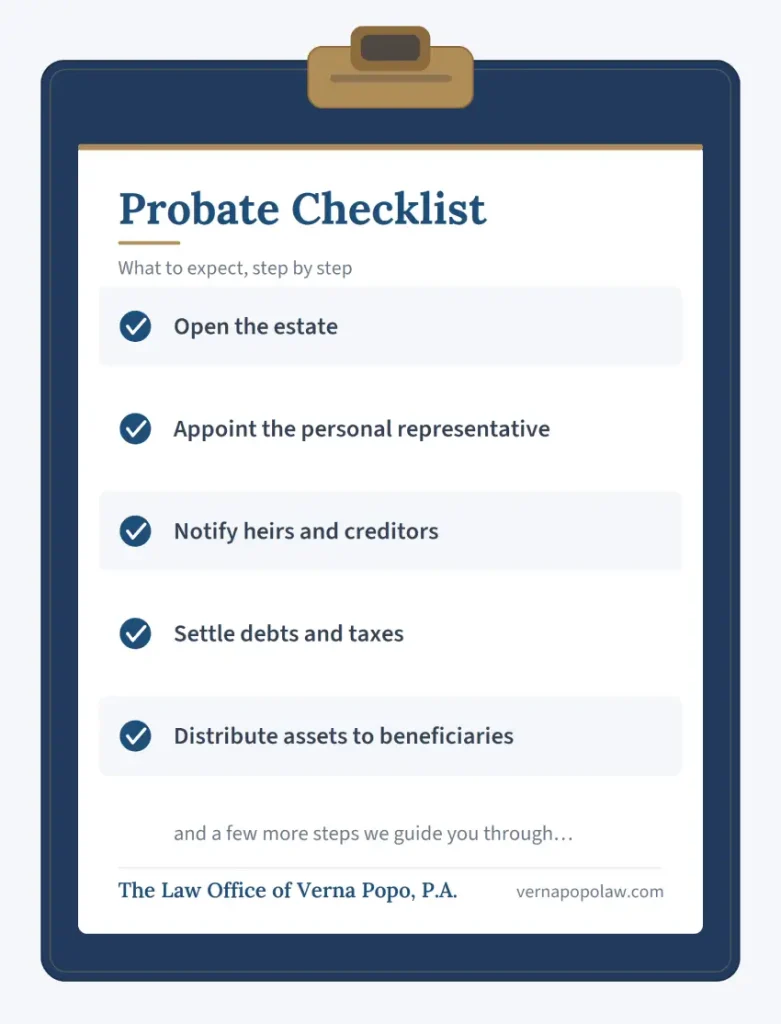
Probate has a rhythm. Knowing the steps ahead of time takes some of the uncertainty out of it.
Estate planning is almost always flat‑fee work, so you know the cost before we begin. The right package depends on how much probate avoidance and protection you want.
A solid foundation for families with straightforward estates.
Keeps your estate private and out of probate.
It depends on the track. Summary administration for a qualifying small estate can close in roughly four to eight weeks. Formal administration usually runs six months to a year or more, largely because of the creditor‑claim period and the steps required to inventory assets, resolve debts, and account to the court. Contested estates take longer.
Often, yes. A will doesn't avoid probate — it directs how the estate is distributed once it goes through the court. Probate is generally needed whenever the decedent owned assets in their name alone with no beneficiary designation or survivorship feature. Assets held in a funded living trust, or passing by beneficiary or joint title, typically skip the process.
Florida's intestate succession statutes (Sections 732.101–732.111) decide who inherits, usually the surviving spouse and children in proportions set by law. Unmarried partners, stepchildren, and friends generally receive nothing under those rules, and the court appoints a personal representative. A valid estate plan is the only way to change that default.
Summary administration is the simplified track for smaller or older estates — non‑exempt assets up to $150,000 (effective July 1, 2026; $75,000 before that date), or any estate where the decedent has been gone more than two years. No personal representative is appointed and there's no formal accounting. Formal administration is the full, supervised process used for everything else.
The personal representative (called an executor in some states) gathers and protects the estate's assets, notifies and pays valid creditors, files any required tax returns, and distributes what's left to the beneficiaries. It's a fiduciary role with real legal duties, which is why most personal representatives work with an attorney — in fact, Florida generally requires one for formal administration.
Florida homestead is treated specially. Under Article X, Section 4 of the Florida Constitution it's protected from most creditors and its value is excluded from the small‑estate calculation, but title still usually needs to be confirmed through the court so it can pass cleanly to the heirs. I handle those homestead determinations as part of the case.
Whether you’re an executor, personal representative, or a family member seeking guidance, we’re here to help. We’ll explain your options, answer your questions, and develop a clear plan tailored to your situation. Your initial consultation is always free and completely confidential.
Whether you’re an executor, personal representative, or a family member seeking guidance, we’re here to help. We’ll explain your options, answer your questions, and develop a clear plan tailored to your situation. Your initial consultation is always free and completely confidential.